
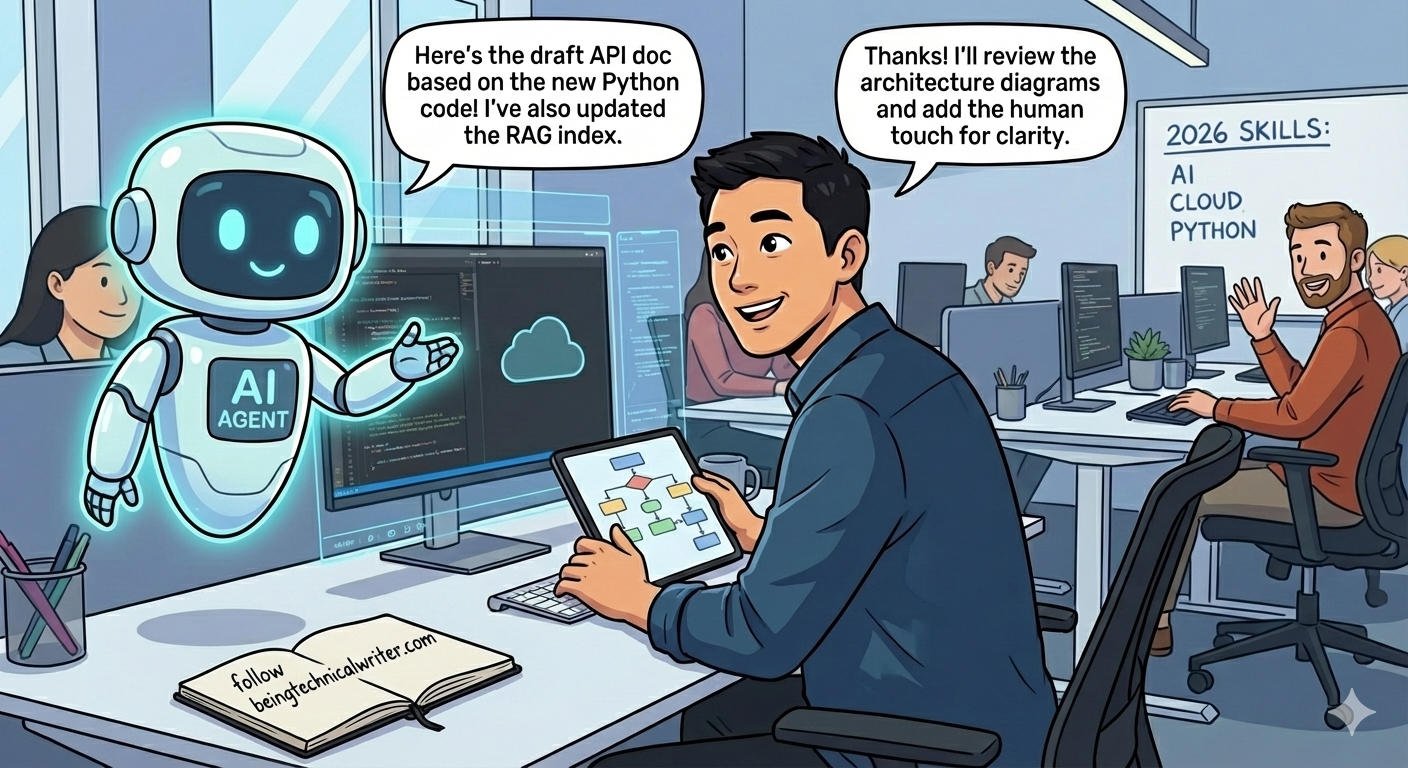
Let me be direct. If your 2026 career strategy is “keep doing what worked in 2025,” you’re not planning. You’re hoping.
Hope is lovely. It’s also not a skill.
The technical writing landscape isn’t just shifting. It’s doing that thing where the ground opens up beneath you and everyone pretends they saw it coming. Job postings that used to say “excellent writing skills” now casually mention “experience with AI tools, cloud platforms, and Python preferred.”
Preferred. As if it’s optional. As if they won’t quietly filter out everyone who doesn’t have it.
Here’s the uncomfortable reality. Writing is still valuable. But writing alone is becoming table stakes. The minimum requirement to enter the game, not to win it.
So let’s talk about what actually wins.
This isn't a prediction piece.
This is a survival guide.
The job market is sending signals (are you listening?)
According to recent industry analysis, technical writer roles are evolving from “content creator” to “content orchestrator.” The shift isn’t subtle.
The message is clear. Generalists are out. T-shaped professionals are in.
You still need deep expertise in writing. But you also need horizontal skills that let you collaborate meaningfully with engineering, data science, and product teams.
Let’s break down what those skills actually look like.
The skill stack (organized by survival priority)
Master These or Struggle
Serious Competitive Advantage
If Writing Evolves Beyond Recognition
Now let’s go deeper on each.
Cloud: Pick one, go deep
Here’s a secret that cloud certification marketing doesn’t tell you. You don’t need to know all three major clouds. You need to know one really well.
Azure
Enterprise favorite. Strong in hybrid cloud. Microsoft ecosystem integration.
AWS
Market leader. Most services. Largest community.
GCP
AI/ML powerhouse. BigQuery is exceptional. Kubernetes native.
My recommendation? Start with Azure Fundamentals (AZ-900) if you’re in enterprise tech, or AWS Cloud Practitioner if you’re in startup land. The concepts transfer. Once you understand one cloud’s IAM, networking, and compute models, the others are dialects of the same language.
What I'm doing
I'm going for Azure certification this year. Not because Azure is "best" but because my work environment runs on it. Theory without practice is just trivia.
Docker and Kubernetes: The new literacy
If someone asks you to “spin up a container” and you think they’re talking about Tupperware, we need to fix that.
Hot take: Technical writers who understand containers are 10x more useful than those who don't. Not because they'll run production systems but because they'll stop asking engineers to explain the same concepts seventeen times.
Engineers notice this. They remember who makes their life easier.
What I'm doing
I'm lucky here. My org gives me hands-on Docker and Kubernetes experience daily. If yours doesn't, spin up Minikube locally and break things on purpose. That's how you learn.
Python and AI: The two paths
Let’s clear up a common confusion. When people say “learn AI,” they’re conflating two very different paths.
Model Creators
What they do: Train models from scratch. Fine-tune architectures. Optimize hyperparameters. Publish papers.
Skills needed: Deep math including linear algebra, calculus, and statistics. PyTorch or TensorFlow. Research methodology.
Job titles: ML Researcher, Data Scientist, AI Research Engineer
Application Builders
What they do: Use existing models to build products. Orchestrate AI agents. Create RAG systems. Deploy solutions.
Skills needed: Python, LangChain and LangGraph, Vector databases, Prompt engineering, API integration
Job titles: AI Engineer, ML Engineer, Solutions Architect
For technical writers, Path 2 is the sweet spot.
You don’t need to understand the mathematical foundations of transformer architectures. You need to understand:
Why does this matter for technical writers specifically?
Because the products you’ll document are increasingly built this way. Understanding the architecture means understanding what you’re explaining. It means asking intelligent questions. It means catching errors before they reach users.
What I'm doing
Last year I learned Python. This year, I'm building projects. LangChain applications, RAG systems, data analysis pipelines. I'm planning to participate in Kaggle competitions to pressure-test my learning against real problems.
Theory is comfortable. Projects are where you discover what you don't know.
Writing isn’t dying. It’s shapeshifting.
Here’s where I push back on the doom narrative.
Writing isn’t becoming irrelevant. It’s becoming different.
The core skill of communicating complex information clearly remains valuable. But the implementation of that skill is evolving rapidly.
Writers who adapt become more valuable. Writers who resist become… well, they become the ones complaining on LinkedIn about how AI is ruining everything.
The backup plans (because reality)
Let’s be honest. Nobody knows exactly where this is going.
I don’t. You don’t. The people confidently predicting the future on stage at conferences definitely don’t.
So here are actual backup plans. Not “keep learning” platitudes, but concrete alternative paths if technical writing transforms beyond recognition.
AI Solutions Architect
What it is: Designing AI systems for business problems. Less coding, more architecture and strategy.
Why it fits: Technical writers already translate between business and technical. This is that skill applied to AI systems.
Path there: Cloud certifications plus AI/ML fundamentals plus solution design experience
AI Ethics and Governance
What it is: Ensuring AI systems are fair, transparent, and compliant. Policy meets technology.
Why it fits: Growing regulatory pressure like the EU AI Act means companies need people who can articulate AI risks clearly. Sound familiar?
Path there: AI fundamentals plus policy and compliance knowledge plus communication skills. You already have these.
Data Analysis and Business Intelligence
What it is: Turning data into insights and recommendations. Dashboards, reports, storytelling with numbers.
Why it fits: You already structure information for audiences. Data analysis is that skill applied to numbers instead of words.
Path there: SQL plus Tableau or Looker or Power BI plus statistics basics plus domain expertise
The common thread? All of these leverage your existing communication skills while adding technical depth.
The uncomfortable truth about timing
Here’s what I’ve noticed. The technical writers who are thriving didn’t wait for permission. They didn’t wait for their company to provide training. They didn’t wait for the “right moment.”
They started learning messy, building broken things, and figuring it out as they went.
That’s not inspiring advice. It’s just true.
Your 90-day action plan
Let me make this concrete.
The question that matters
It’s not “Will AI replace technical writers?”
It’s not “Which skills are most important?”
It’s not even “What should I learn first?”
The question that actually matters is:
Are you building optionality, or are you hoping your current skills remain valuable?
Hope isn’t a strategy.
Learning is.
What skills are you prioritizing for 2026? What’s your backup plan? I’d love to hear. Drop a comment or find me on LinkedIn.
Join the Discussion